Planning a trip to Rio de Janeiro? Here’s our full itinerary, real costs, safety notes, and what we’d prioritize after visiting ourselves (twice).
Disclosure: This post may contain affiliate links, which means we’ll receive a commission if you purchase through our links, at no extra cost to you. Please read full disclosure for more information.
Updated October 2026.
The best way to spend 5 days in Rio is to base yourself in Leblon, Ipanema, or Copacabana, then split your days between the big views (Sugarloaf, Christ the Redeemer), the neighborhoods (Lapa, Santa Teresa, Ipanema), and one nature day (Tijuca Forest or Pedra do Telégrafo).
On our trip, we spent about $85 a day for two on food, activities, and rides, not counting our hotel (full breakdown in the cost table below). Heads up for 2026: US Citizens now need an e-Visa to enter Brazil, and the State Department’s advisory for Brazil was updated on August 31, so read the visa and safety sections before you book.
Prices in this guide are from our March 2024 trip unless noted, and we’ve updated tickets and rules as of October 2026.
Rio de Janeiro is often called the “Marvelous City” (Cidade Maravilhosa), and it truly lives up to its name.
From its stunning beaches andmountainous landscapes to its vibrant energy and delicious local treats like açaí and cupuaçu (more on that later), Rio is captivating at every turn.

Having recently spent five unforgettable days exploring this city (for the second time), I’m excited to share my insights and tips to help you create an incredible experience of your own.
This is all about creating the perfect 5 day itinerary for Rio de Janeiro, Brazil.
As one of our favorite cities in the world, we want to help you love it just as much as we do, by ensuring you’re fully prepared with a plan.
Let’s get you ready for Rio!
Here’s a quick glimpse at the Rio de Janeiro Itinerary: Day 1: Arrival, Check-In, Tijuca Forest, Sugarloaf Mountain Day 2: Mirante Dona Marta, Christ the Redeemer, Parque Lage, Ipanema Beach Day 3: Escadaria Selaron, Parque das Ruinas, Museu do Amanhã, Copacabana Beach Day 4: Pedra do Telégrafo, Pedra do Sal Day 5: Departure
Day 1: Arrival, Tijuca Forest, Sugarloaf Mountain Cable Car
I flew with Avianca for $430.85 USD roundtrip from JFK to Rio de Janeiro, including a layover in Bogota, Colombia.
This was a pretty big journey. Just the flight from New York to Colombia was about 6 hours, and then the overnight flight from Colombia to Rio’s airport was about 6.5 hours.
If you have an overnight flight, I recommend you sleeping during the nighttime so you’ll be ready for the day once you land.

I flew into Galeão International Airport (GIG), but you can also fly into Santos Dumont Airport (SDU) if you are flying domestically within Brazil.
GIG is the only international airport in Rio. However, SDU is closer to downtown Rio de Janeiro and ultimately more convenient to fly into if you are already in Brazil exploring another area such as São Paulo.
We took an uber for $17.51 USD that took around 60 minutes to get to our accommodation from Galeão.

After freshening up, it was time for a little adventure to kick off our time in Rio.
RELATED Top 9 International Travel Essentials | How to Use Credit Card Points for Flights
Breakfast at Zona Sul Supermarket
We grabbed some breakfast at Zona Sul which is a local grocery store to fuel up for our day. These stores are everywhere in Rio, and we saw many throughout the city.
This particular location had a lot of self-serve food, which was very convenient for us.
I opted for a mushroom pizza, and my husband chose a sandwich for $7.50 USD total.
The self-checkout made the process easy, and we didn’t have to worry about our lack of Portuguese skills.
Cascatinha Taunay Waterfall in Tijuca Forest
We took a nature walk through Tijuca National Park to Cascatinha Taunay, a waterfall perfect for those who want to immerse themselves in nature without really breaking a sweat.

It’s not an actual hike though; our Uber dropped us near the entrance of the Tijuca Forest, and from there, it was a 5-minute walk to the waterfall. Entry is free.

The water is cool, and there are multiple layers to the waterfall. You can walk under a bridge to get a better view of the larger falls.

If you’re feeling adventurous, there are other hiking trails to explore in Tijuca Forest. We’d recommend that you do more exploring only during the daylight hours.
Cafe e Mar
We needed a little pick-me-up, and our Airbnb host recommended we check out Vidigal, a well-known favela.

We found a charming coffee shop called Cafe e Mar with incredible views. I had an almond milk latte, and my husband tried their fresh mango juice. Altogether, we spent $5.33 USD.

This place was a bit challenging to find as it was higher up the mountain than where our Uber dropped us off.
We ended up walking up the mountain for about 10 minutes to reach it.
A note on visiting Vidigal: Our Airbnb host recommended Cafe e Mar, and the views were incredible. But Vidigal is a favela, and we’d tell readers to be a bit more careful than we were.

They also serve food, but we arrived between 1 and 2 pm, which is when they take their lunch break.
Food service resumed after 2 pm.

Sugarloaf Mountain Cable Car
Sugarloaf Mountain, also known as Pão de Açúcar, is an iconic site in Rio de Janeiro.
The name comes from the traditional shape of concentrated refined loaf sugar.

We took a $6 USD Uber from our Airbnb to Praia Vermelha which is right where you get on for the cable car.

We booked our tickets for the cable car in advance for ~$33 USD per person in 2024. Current ticket listings run about $37 to $40 per adult, so budget for that.
When you arrive, you won’t want to wait in line to purchase a ticket, as that can take a while.

There’s a separate line for those who pre-booked their tickets, and it moves quickly with barely any wait time.
The cable cars come frequently, about every 5 minutes.
Each time you enter a cable car, both going up and coming down, you need to re-scan your ticket, so be sure to keep it on you and don’t lose it!
There are two cable rides to Sugarloaf Mountain. Each ride lasts about 3 minutes, but the views are incredible!

The first stop offers a lot to see: colorful graffiti on the walls, the viewpoints of the city along the water, and options for helicopter ride

There are also plenty of food and snack stands.
We even saw a monkey! At first, I wasn’t sure if it was a monkey because I had never seen one quite like it.
There were signs warning not to feed the monkeys, which confirmed that it was indeed a monkey and not some other exotic animal.

From the top, you get even more incredible views of Christ the Redeemer.
This world wonder is especially stunning during sunset, but be prepared for crowds.
You’ll need to squeeze your way through to capture your own memories.

Yaya Comidaria Pop Brasileira
After visiting Sugarloaf Mountain, we took an Uber for $2.68 USD to a nearby Black-owned restaurant called Yaya Comidaria Pop Brasileira.

This was more than a restaurant—it was truly an experience.
The aesthetics, the flavors, the textures—everything was so memorable and on point.

They offer menus in both Portuguese and English, depending on your preference.
I started with a pineapple and chamomile drink that struck the perfect balance of tartness and calming flavors.

My husband had the coconut lemonade, which he really enjoyed.
We began our meal with an appetizer of fritters with shrimp. I also added some of their flavorful house-made hot sauce, which was a great complement.

For our entree, we shared the shrimp bobo. The shrimp came in a clay pot with a stewy, flavorful sauce.

The rice was delicious on its own, with the largest grains I had ever seen.

Mixing it with the shrimp created the ultimate combination, and adding the crushed cassava flour provided a wonderful texture to the entire dish.

We spent $54.27 USD on our dinner experience here.
Yaya is a 10/10, and I would recommend it again and again to anyone looking for the best food in Rio.

Day 2: Dona Marta Viewpoint, Christ the Redeemer, Parque Lage, Ipanema Beach
Sunrise at Mirante Dona Marta
Waking up before sunrise to catch a view might sound crazy to some, but it was the perfect start to our day.
We have an entire blog post on how we visited Mirante Dona Marta, how to capture the best images and take in the greatest views of Rio at sunrise—be sure to check it out!

The clear view of Christ the Redeemer statue from Mirante Dona Marta convinced us that this was the perfect day to visit. We were glad to see the statue wasn’t obstructed by clouds!

We bought our tickets for Christ the Redeemer online right away for the first time slot to visit the World Wonder.
Christ the Redeemer
After visiting Mirante Dona Marta, we made our way to Paneiras Corcovado, about a 10-minute drive deeper into Tijuca Forest.
Here’s what’s changed since our first visit. The escalators up to the statue’s platform were switched off on August 3, 2026 for replacement, with the work expected to wrap up by the end of May 2027. You now climb about 80 stone steps at the end, and the site is running at roughly half its usual capacity. Book your ticket in advance and take the earliest slot you can (we’d say 8 AM).
The official van from the Paineiras Visitor Center starts at roughly R$60 to R$87 and the Corcovado train at roughly R$107 to R$134. The official Paineiras Corcovado site now recommends booking the 8 am first slot, and the visitor center opens at 7:20 am. Tickets include the round-trip van ride and entry to the statue.
Booking tip: book a time slot in advance if you can, then check the weather the night before. A clear view from below usually means a clear view at the top.

The price included the entry fee and transportation up to the top where Christ the Redeemer was located.
It’s not worth going if the view is covered in clouds; if you can’t see the statue from below, you won’t see it up close either.
We had booked the very first time slot at 7 am through the official website.
Finding an Uber from Mirante Dona Marta was challenging—many canceled or were too far away.
Fortunately, we made friends at Dona Marta who kindly drove us to Paneiras Corcovado.
I highly recommend arranging transportation from Mirante Dona Marta in advance to avoid getting stuck there.
We arrived at Christ the Redeemer around 6:50 am. Although the doors didn’t open until about 7:20 am, a long line had already formed.

By 7:30 am, they started scanning our tickets, and we followed the path to the vans.

The vans, equipped with AC, took us on a very curvy 5-minute ride up to Christ the Redeemer.

After another ticket scan, we took an elevator and then an escalator to reach the statue.

The statue of Christ the Redeemer sitting atop Corcovado Mountain was much larger and more impressive than I had imagined, especially with the clear view we had.
Despite the early hour, there were many people there—after all, it is one of the Seven Wonders of the World.

It was fun to take photos and even witness a marriage proposal.
An interesting fact I learned is that originally, a monument was planned to honor the woman who ended slavery in Rio. However, she insisted it be of Jesus, the true savior.

The statue took five years to build and was completed in 1931. With its 100th anniversary approaching, it will undoubtedly attract many visitors.
The views of Christ the Redeemer and all of Rio were truly breathtaking.

Plage Cafe at Parque Lage
Next up, we took a $4.37 USD Uber from Christ the Redeemer to Plage Cafe, which opened at 9 am. This is another place where arriving early is key, which seems to be a theme in Rio.
Plage Cafe is inside Parque Lage, a free park at the foot of Corcovado Mountain. Currently, Plage Cafe is under renovation.

If you loved the “Beautiful” music video by Pharrell and Snoop Dogg, you might recognize this spot from the party scene at the end of the song.
Eight-year-old me would be thrilled to finally be here, having imagined myself in the video way wayy back then.

We arrived around 8:45 am, just a 15-minute drive from Christ the Redeemer. You can even see the statue from the cafe.
Once they started letting people in at 9 am, there were two lines: one for taking pictures and one for being seated for food.

We opted to take our pictures first, which took about 10 minutes from the time we started lining up, and then we were seated to eat.

I had the vegetarian lasagna, which featured eggplant and delicious cheese, served in a skillet. I also had a vanilla latte.

My husband saved his appetite and only got a tropical drink, which was pretty good as well. Altogether, we spent ~$17 USD.

We sat near the pool area, which was great for people-watching and seeing everyone have their own mini photo shoots as we waited for our orders.
Keep in mind, Rio is HOT.
They have umbrellas at each table, but try to find the shadiest spot or opt for indoor seating.
If you come later in the day, wait times are longer, so it’s best to make a reservation if possible. Again, Cafe Plage is currently undergoing renovations, but we look forward to when they re-open!

After eating, we walked around Parque Lage and saw lots of monkeys in the trees, eating fruits and then tossing them down.
Be careful not to stand too close to the trees to avoid getting accidentally hit.

Afterwards, we headed back to our Airbnb to relax and refresh before heading to one of Rio’s many beaches!
Leblon Beach
Leblon Beach was pretty close to where we stayed, as our Airbnb was located in Leblon.
The beach was very crowded. You can rent an umbrella and chair combo for $15 USD, but it was so packed that it looked like there was no space for another umbrella to squeeze in.
The water was chilly and not very blue as it came to the shore, almost reminding me of the beach water on Long Island in New York.
Asa Acai
We walked a few blocks from Leblon Beach to grab an acai bowl from Asa Acai. There’s more than one location, but we visited the one in Leblon.

Since acai was created in Brazil, it’d be wrong to come all the way here and not try the original version.
At Asa Acai, there’s a self-serve kiosk where you basically build your own bowl.
I ordered an acai bowl with acai, honey, granola, banana, and strawberries.
My husband ordered a split bowl with acai and cupuaçu, another superfruit, along with banana, strawberries, and some sort of tapioca.
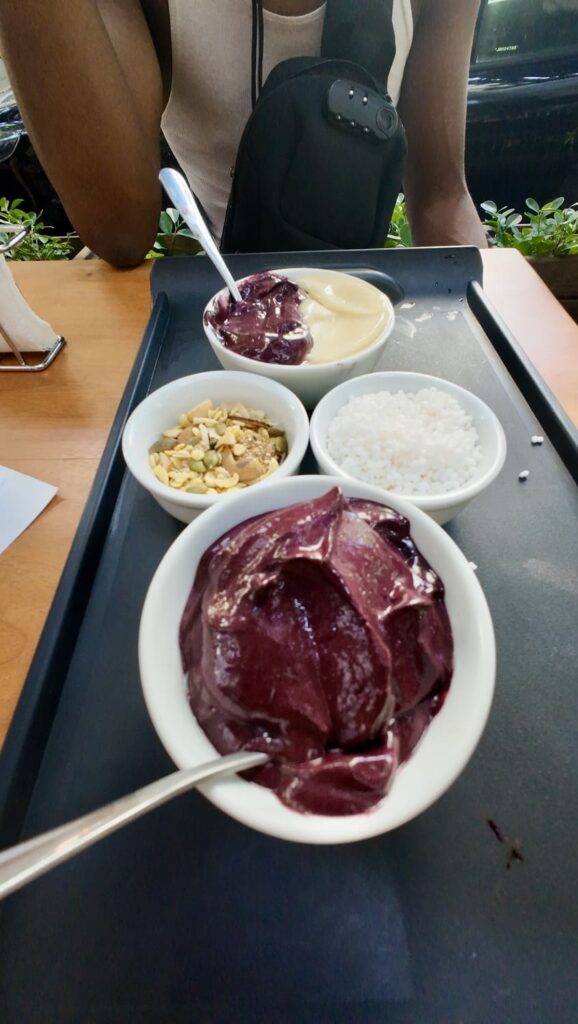
Each of these acai bowls cost about $5 USD, but ranges from $3 USD to $7 USD depending on the size you get.
Go with the larger size, you won’t regret it!
I tried some of my husband’s bowl, and cupuaçu instantly became my favorite thing.
I never tasted anything like it, and I immediately became obsessed. It’s slightly tangy, but mostly smooth and sweet.
BB Lanches
Directly across the street from Asa Acai, we spotted BB Lanches, a food place with lots of baked options.
I went for the cheese bread, which was delicious. As a fan of Brazy Bites back home, I knew I’d love these authentic Brazilian Bites.
They also have cups of acai and cupuaçu to enjoy.

My husband tried one of their options with chicken inside the pastry, and he enjoyed it.
Altogether, this cost ~$7 USD. It’s worth noting that they are a cash-only establishment – the first place where we had to use cash during our trip.
Ipanema Beach
Continuing along down Leblon Beach, you’ll arrive at Ipanema Beach, where vendors line the shore, selling a variety of items like bracelets, paintings, and beach blankets (really more of a beach sheet known as a “canga”).

If you venture further along Ipanema Beach towards its end, you’ll encounter huge rocks where many people gather to catch the sunset at Arpoador.
Arpoador Rock: The Best Sunset Spot in Rio
The sunset at Arpoador is truly remarkable, with the sun setting behind the mountains and the twinkling lights of the favelas emerging as darkness falls.

After sunset, lights illuminate the rocks, providing visibility for vendors skillfully navigating with drinks, food, and even card machines, as most accept credit cards.

Yes, even small vendors have credit card machines on hand. It’s a good idea to come to Rio with a credit card that has no foreign transaction fees.
However, you should be cautious because the rocks can get tricky to walk down, leading to potential falls.

Dinner at Bar do Adao
Bar do Adao has more than one location, but we went to the Ipanema location. The outdoor seating had a pleasant atmosphere.
While the menu was primarily in Portuguese, they conveniently offered a QR code to scan for the English menu.
Either way, we were prepared with our Translate app on our phones, ready to capture and translate the menu into English which is something you could do if you encounter a non-English menu.
For our meals, my husband ordered the shepherd’s pie which was comprised of mashed potatoes, shredded meat, and different types of cheese.

I chose a simpler option—a fried pastry filled with a blend of four cheeses including parmesan and brie.
It reminded me of the delicious pastechi I enjoyed in Aruba. Altogether, we spent $15.17 USD.
Day 3: Escadaria Selarón, Museum of Tomorrow, Copacabana Beach
Escadaria Selaron
We woke up earlyyy to visit this iconic staircase from Snoop Dogg and Pharrell’s “Beautiful” music video (a personal favorite from my childhood).

Even though that’s why I was so excited, this staircase is iconic for more reasons than one.
I have an entire blog post on this famous Rio staircase designed by the artist Jorge Selaron that you should check out for more details.

You can also add in a visit to Arcos da Lapa (the white aqueduct arches) nearby the Selaron Steps.
Breakfast at Bar e Restaurante Os Ximenes
After we visited Escadaria Selaron, we went to the cafe right across the street from the entrance of the steps called Bar e Restaurante Os Ximenes.
It was located right at the corner of the Murals of the Lapa District.

We ended up getting a couple of cups of fresh acai, but they also have an entire menu if you’re ready for a meal.

Parque das Ruinas
The walk to the ruins at Parque das Ruinas from Escadaria Selaron seems close but can be strenuous.
While Google Maps may suggest it’s only an 8-minute stroll, realistically it took us around 30 minutes to climb up the steep hills in the blazing Rio heat.

When we arrived at the ruins we found local vendors offering an array of items for purchase.

You can also find great views of Sugarloaf Mountain on the upper side of the ruins, next to the food stand.

Despite the challenging journey, the ruins proved to be a worthwhile stop, conveniently located near the Escadaria Selaron, and free to enter.

Lunch at Botequim Os Ximenes
Next up, we headed to Botequim Os Ximenes from the ruins. When we arrived, we were greeted by the friendly owner, although communication was a bit challenging as he didn’t speak English.

I had the broccoli rice, and legumes while my husband had fish with rice and mashed potatoes.

Everything we had was delicious and altogether cost $16.81 USD.
Museum of Tomorrow
The Museum of Tomorrow (Museo do Amanha) offers an immersive experience exploring the origins of the universe and emphasizes the importance of sustainability for future generations.

Just from the exterior, you can tell something futuristic lies behind those front doors. It was designed by the the Spanish architect Santiago Calatrava.

They’re open from 10 am – 6pm (closed on Mondays), and costs ~$5 USD per person to enter.
The museum features a stunning viewing deck with impressive views.

It was extremely hot when we visited in March, so we enjoyed the views through the floor to ceiling windows with the AC blasting inside.

Outside the museum, you’ll find vendors selling açaí, clothing, and sandals.

It’s a convenient spot to pick up souvenirs or essentials. I was especially grateful for this since my sandal strap broke as I was walking to the museum, and I could buy a new pair right there.

Before heading to your next destination, stop by Café Sterna, a quaint café just up the street from the museum. It’s the perfect spot to enjoy a coffee and recharge for $4.53 USD

Copacabana Beach
Copacabana Beach is one of the most popular beaches in Rio. The lively boardwalk is lined with open-air restaurants, many featuring live music.
The atmosphere is vibrant, with numerous vendors selling various items.
I bought a canga, a large sheet perfect for laying on the beach.

We also tried street corn from a vendor. She scraped it right off the cob, and we could add our own butter and seasonings.

After enjoying the local flavors, it was time to relax on the beach.
Dinner: Braseiro
Braseiro is a restaurant located near Copacabana Beach that specializes in various steaks. It’s an excellent option for steak lovers, but not ideal for vegetarians.

I opted for the side dishes of rice and fries, and for dessert, I enjoyed fried bananas with cinnamon. A truly miscellaneous plate if I say so, myself.

My husband had the steak and savored every bite. He also ordered a traditional Brazilian soda called Guaraná Antarctica .

The meal was reasonably priced at ~$19 USD for everything we ordered, offering good value for the quality of food and service.
Day 4: Nusa Cafe Brunch & Bistro, Pedra do Telegrafo, Rio Botanical Garden, Pedra do Sal
Brunch at Nusa Cafe
We enjoyed brunch at Nusa Cafe Brunch & Bistro in Leblon. The menu had great breakfast options, including vegan choices.

When you step inside you immediately feel the Bali vibes and reminded us of our time visiting Nusa Penida off the coast of Bali.

I had toast with avocado, mushrooms, and tomato, paired with a veggie cappuccino – which was a funny way to put it because I think it just meant they used almond milk.

My husband ordered the papaya filled with peanut butter, bananas, kiwi, blueberries, strawberries, and granola.

I probably tried more bites of his plate than he wanted me to, but it was too good to pass up!
The fresh and healthy ingredients made for an incredible first meal of the day, costing $15.18 USD altogether.

Pedra do Telegrafo
Pedra do Telégrafo is about an hour away from Rio and the Uber cost us ~$14 USD.
This is a moderate hike that leads to a popular photo-op spot that looks like you are hanging off the edge of a rock.

When you get dropped off here at the Estacionamento, you’ll likely be offered a motorbike ride up to the trailhead, but we decided to walk.

It actually isn’t a bad idea to take the motorbike, especially if it’s very hot.
But don’t worry, there are plenty of large rocks to chill out on for those moments when you need a little break on your hike. Be sure to bring some water to stay hydrated!

The streets are very steep, and it took us about 20 minutes to reach the start of the trail.

Follow the white arrows on the road, then head up and to the right along a road, rocks, and dirt trail for about 30 minutes.

You’ll reach a sign and go through a small gate, then walk for another 15 minutes.
Many people visit this viewpoint early in the morning to avoid long wait times.
While it’s common to go right after sunrise, we went around 11 am and only waited about 30 minutes for our turn to take pictures.

The early morning crowd had started to dwindle by then, so you can enjoy a more relaxed start to your day and still have a great experience at Pedra do Telégrafo.
There is a photographer on site who will take pictures for you for a small fee, or you can bring your own camera to take pics on your own, just gotta get the angles right to not show the ground beneath you in the photo.
Make friends with the people you’re in line with to take each other’s pictures.

Rio Botanical Garden
If hiking isn’t your thing but you’d still like to spend some time in nature, check out the Rio Botanical Garden as an alternative to hiking to Pedra do Telegrafo.
Founded in 1808, the garden is home to more than 20,000 plants in its living collections. Visitors typically spend about 1.5 – 2 hours here, and can walk or take an electric cart, and there’s a Japanese Garden plus greenhouses. The avenue of towering royal palms and the shaded paths are the classic images of the place, and there are views of Christ the Redeemer above the palms.
Getting there from Leblon or Ipanema: It’s a short ride inland. Ask your driver for the main entrance at Rua Jardim Botânico 1008. That’s the gate with ticket booths, open daily.
The garden is open every day. The arboretum is open Thursday to Tuesday, 8am-5pm, and on Wednesdays 11am-5pm because of morning maintenance. It closes on December 25 and January 1, and has shortened 8am-2pm hours on December 24 and 31.
It costs R$40 for visitors living in Brazil and R$80 for foreign visitors. Half-price tickets are available for students, seniors 60+, people with disabilities and young people up to 21, and children up to 5 are free. The box office takes only cash or Pix, while online tickets accept Pix or credit card. Most foreign visitors will find buying online with a card easier.
Café e Bar Stalos
If you really know me, then you know that pizza is my favorite food, and I eat it all the time.
But this was my first time eating it with a fork and knife. Being a lil bad and bougie.
I looked around and saw the whole restaurant doing it, so I did the same.
The slices are huge at Cafe e Bar Stalos, and the crust has a creamy cheese filling.

I had a shrimp slice and a cheese slice. My husband had the pepperoni pizza slice.
We also had natural juices—pineapple mint for me and a traditional Brazilian orange-flavored drink for him.
Altogether, we paid $16.01 USD at Cafe e Bar Stalos.
Pedra do Sal
Pedra do Sal hosts a lively samba night every Monday, starting after 8 PM (it’s usually called off if it rains). Day 4 of this itinerary falls on a Monday, so start your trip on a Friday to catch it.
Since the Museum of Tomorrow is closed on Mondays, plan it for any other day.
Of course, you can shuffle the days to suit your own plans. Just keep these two in mind: samba at Pedra do Sal is on Mondays, and the Museum of Tomorrow is closed Mondays.

The Pedro do Sal area has a rich history—it was once a Quilombo village where freed slaves lived, and it’s been a major area for Brazilian music ever since.
Grab a caipirinha from one of the vendors, enjoy the street food, and watch the locals show off their samba skills.


It’s like a massive block party, so be smart about what you bring—nothing flashy or easy to grab. Just come ready to soak in the energy and enjoy the night.
This was the perfect way to end our time in Rio!
Day 5: Departure
You’re at the end of your unforgettable time in Rio, but before you head out, let’s make sure your departure is as smooth as the rest of your trip!
First, double-check that you’ve packed everything—especially those last-minute items like phone chargers, passports, and souvenirs.
If you have any reals left, it might be worth grabbing a snack or two from a local bakery or airport shop for the road.
Getting to the airport: Our Uber from Galeão (GIG) to our Leblon Airbnb was about $17.51 and roughly 60 minutes in 2024. Allow extra time for traffic. If you’re flying domestically, you may leave from Santos Dumont (SDU), which is much closer to downtown.
Plan to get to the airport at least three hours before your flight, especially if you’re flying internationally. Rio’s Galeão Airport can get busy, so give yourself plenty of time to get through security and find your gate without rushing.
While waiting for your flight, take one last moment to soak in Rio’s energy.
If you didn’t grab a caipirinha at Pedra do Sal, there are a few airport spots where you can sip one final drink, or grab one last açaí and relive your favorite memories.

Rio de Janeiro Tips
Here is a summary of tips to keep in mind for your trip to Rio de Janeiro, Brazil.
How to Get Around
We mainly used Uber, which is very affordable and convenient in Rio.
You can also use the public transport like the metro and light rail, but Ubers are often a safer and more comfortable option, especially for tourists.
Do You Need a Visa for Brazil?
Yes, if you’re a U.S. citizen, you now need an e-Visa before you fly. Brazil brought back its visa requirement for Americans, Canadians, and Australians on April 10, 2025. When we visited in March 2024, it was still visa-free, so our trip didn’t need one, but when we visited again in November 2025, we had to do the e-visa process.
- Cost: US$80.90
- Validity: 10 years with multiple entries for U.S. citizens
- Stay: up to 90 days per visit
- No visa on arrival. Airlines check at check-in, so no approved e-Visa means no boarding pass.
- Apply here: official Brazil e-Visa portal
Apply well ahead of your flight. Requirements for other passports differ, so confirm on the official portal.
What to Pack
- passport and Brazil visa
- comfortable walking shoes
- sunscreen
- reusable water bottle with filter straw (tap water is not safe to drink in Rio de Janeiro)
- light clothing for the hot weather
- sun visor or sun hat
- swimwear
- universal power adapter
- antitheft day bag
- waterproof bag/waterproof fanny pack
- bug spray
Where to Stay in Rio
Our pick: Leblon or Ipanema for a first trip. We stayed in this Airbnb in Leblon for $46 a night in March 2024, close to the beach, açaí shops, and restaurants. Copacabana is the best choice if you want more hotel options and a metro stop, Botafogo is better for value, and Santa Teresa is best for atmosphere.
We broke down every neighborhood, with hotels at every budget, in our full where to stay in Rio de Janeiro guide.
Seasonal Tips
Rio is located in South America so its seasons are opposite to those in North America. However, you’ll find warm weather all year round in Rio.
The hottest weather is from November through March, with temperatures sometimes going over 100°F (43°C).
You can find cooler temperatures during their winter from June through August with temperatures around 80°F (26°C).
If you’re visiting for Carnival, the 2027 Special Group parades at the Sambadrome are February 7 to 9, 2027, with the Champions Parade on February 13. Carnival ends before Ash Wednesday (February 10, 2027), which is earlier than usual because Easter falls on March 28 this year. Street parties (blocos) run in the days around the parades.
If this is your plan, book your hotel now. Rooms in Copacabana and Ipanema fill early and prices climb. Choose free-cancellation rates, and see our where to stay in Rio guide.

Language
Portuguese is the official language. While I know some Spanish, it wasn’t very helpful here. Use the Translate app or Google Translate, as English isn’t widely spoken either.
Currency
The local currency is the Real (BRL). We used a credit card with no foreign transaction fees and found that we hardly needed cash. Tips are usually included in your bill also as a service charge.

Affordability
Rio de Janeiro can be affordable, depending on how you plan your trip. For accommodations, you’ve got options ranging from budget-friendly hostels to mid-range Airbnbs and hotels. We paid only $47 USD per night at our Rio accommodation.
You can grab a cup of refreshing acai or simple street food items from local vendors for ~$5 USD or less.
Sit-down restaurants are a bit pricier but still reasonable, ranging from ~$15 USD to ~$25 USD per person depending on where you go.
For transportation, Uber is incredibly cheap, with most rides around the city costing just ~$3 USD. Even our longest ride, over an hour away, was only $18 USD.
So whether you’re staying on a budget or want to splurge here and there, Rio has affordable options to suit your style.

Is Rio Safe Right Now?
Rio is very doable for tourists, but you need to be deliberate. The U.S. State Department lists Brazil at Level 2, “Exercise Increased Caution.” It updated the advisory on August 31, 2026, citing crime and kidnapping, and it specifically says assaults, including with sedatives or drugs placed in drinks, are common in Rio.
Here’s what we’d actually do:
- Watch your drink. Don’t leave it unattended or accept one from a stranger. This matters most at bars, nightlife areas like Lapa, and street-party events like Pedra do Sal.
- Be careful with dating apps and bar meetups. The advisory notes criminals sometimes target foreigners this way.
- Use Uber door to door at night. The advisory also flags public transport and major transit centers after dark.
- Keep your phone and jewelry low-profile at the beach and at crowded events. An antitheft day bag helps.
- If you’re held up, don’t fight back. Hand over what they ask for.
- Buy travel insurance. The State Department highly recommends it. We use SafetyWing.
We spent most of our time in Leblon, Ipanema, and Copacabana, and used Uber for almost everything. Read your own government’s latest guidance before you book.
Last checked: October 2, 2026. Advisories change, so verify before you travel.
Health Conscious Culture
Rio’s lively, health-focused atmosphere is hard to miss. All around the city, you’ll find outdoor workout stations where locals are busy exercising or playing beach sports to stay active.
Superfruits like açaí and cupuaçu are also a big part of the scene, playing into the city’s overall focus on wellness and healthy living.
Favelas
Favelas are densely populated urban neighborhoods. While they offer a glimpse into local life, it’s best to visit with a guide. Avoid exploring these areas alone, especially at night.

Food to Try
Don’t miss out on local favorites like açaí, cupuaçu (my favorite superfruit), pão de queijo (cheese bread), feijoada (the national dish of stew with black beans and a meat like chorizo), and the famous Caipirinha cocktail.
Christ the Redeemer Tips
This is one of the Seven Wonders of the World. For the best experience, visit early in the day and choose a clear day for the best views.
Sugarloaf Mountain and Mirante Dona Marta offer incredible viewpoints of Christ the Redeemer.
Heads-up for 2026 to 2027: Christ the Redeemer is open, but the escalators are out of service for replacement until roughly the end of May 2027. Plan for a stair climb at the top and book early, because capacity is about half the usual.

Where to Go Outside Rio
If you have more time, consider exploring beyond Rio:
- Arraial do Cabo: Known for its stunning beaches, just a two-hour drive from Rio.
- Iguazu Falls: One of the largest waterfalls in the world, straddling the border between Brazil and Argentina.
- Amazon Rainforest: The largest rainforest in the world.
- Salvador: Home to the largest Black population outside Africa, rich in culture and history. Read more about traveling to Salvador here.
- São Paulo: Brazil’s most populous city, offering a different urban experience.
FAQ
How many days do you need in Rio? Five days (four nights) covers the highlights without rushing: Sugarloaf, Christ the Redeemer, Ipanema and Copacabana, Lapa, one nature day, and a Pedra do Sal samba night.
Do Americans need a visa for Brazil? Yes. U.S. citizens need an e-Visa (US$80.90) before flying, valid for 10 years, and there’s no visa on arrival. See the how to get a Brazil visa blog.
Is Rio safe for tourists in 2026? The State Department lists Brazil at Level 2, “Exercise Increased Caution,” and flags drink-spiking in Rio. Stick to Uber at night, watch your drink, and keep valuables out of sight. See the safety section above.
How much does a trip to Rio cost? We spent about $343 for two on food, activities, and rides over four days, plus $46 a night for lodging, in March 2024 prices. Refresh with current rates before you book.
What’s the best time to visit Rio? The hottest months are November through March. June through August is cooler. Carnival 2027 is February 7 to 9 (parades), so book early for that.
Where should I stay in Rio? Leblon and Ipanema for a first trip, Copacabana for the most hotel options, Botafogo for value, Santa Teresa for atmosphere. See our where to stay in Rio guide.
Is Uber safe and cheap in Rio? Uber was our main way around. Most rides were about $3, and our longest, over an hour, was $18 in 2025.
Rio Itinerary Final Thoughts
Exploring Rio de Janeiro is an unforgettable experience filled with vibrant culture, stunning views, and endless adventure.
For more helpful tips, check out our other related articles to help you prepare for Rio de Janeiro:
If you found this guide helpful, please share it with fellow travelers and help them make the most of their trip to this incredible city!
Read Next: Where to Stay in Rio de Janeiro | Must-Know Tips Before Visiting Rio | Escadaria Selarón Guide | Mirante Dona Marta at Sunrise | Is Salvador da Bahia Worth Visiting? | How to Apply for Brazil Visa